
Quick Answer
- AllStays Camp & RV is the best all-in-one app for big rigs — it covers every overnight stop category with big-rig-specific filters, offline maps, and satellite view for evaluating approach geometry before you drive in
- RV Trip Wizard is the best dedicated route planner for 35–45 foot rigs — input your exact height, weight, and length and it routes around low bridges, weight-restricted roads, and tunnel propane restrictions
- The Dyrt is the best app for pre-trip campground research — satellite overlay, rig length filtering, and site-specific data on pull-through availability and maximum rig age restrictions
- Google Maps satellite view is an underused planning tool — use it to evaluate campground entry roads, loop geometry, and pull-through clearances before your departure, not on arrival
- Hookhub provides direct host communication before booking — the only way to confirm that a private land host can actually accommodate a 42-foot diesel pusher before you commit to a three-day stay
- RV Parky focuses specifically on parking discovery for large vehicles, with stop-level data on site dimensions and clearances at chain stores and truck stops along major routes
Owning a big rig changes everything about how you plan a road trip. The navigation challenges a 40-foot Class A motorhome or a 45-foot fifth wheel faces are closer to what a semi-trailer truck driver manages than what a standard passenger vehicle driver thinks about. Bridge clearances, weight-restricted back roads, tight campground loop turns, low-clearance fuel station canopies, and parking lots that simply cannot physically accommodate 45 feet of vehicle require a different category of trip planning tools.
According to the RVIA’s Spring 2026 RV RoadSigns forecast, 342,200 recreational vehicles were shipped in 2025 — the third consecutive year of growth for the industry. A meaningful share of those units are Class A motorhomes and large fifth wheels entering the market with owners who have never navigated a rig of that size before. First-time owners now make up 36% of all RV owners. Many of them will learn the hard way that standard GPS apps were not designed for a vehicle with a 13-foot height and a 10-foot wide profile.
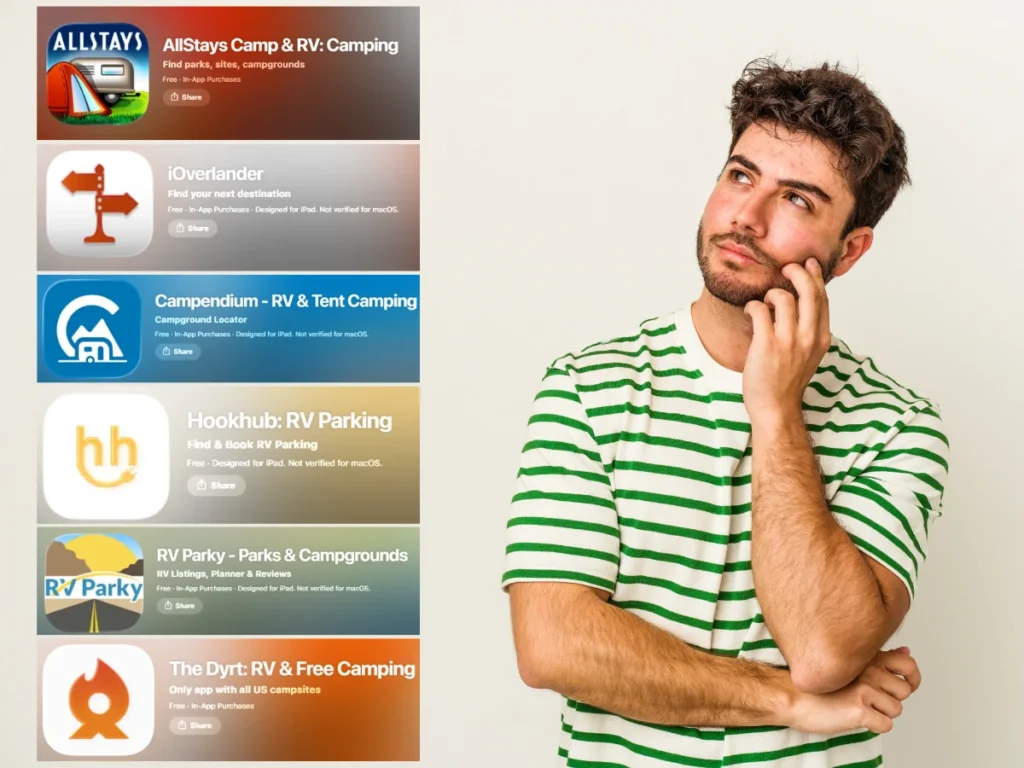
The six apps below are evaluated specifically on what they do for big rig drivers — not tent campers, not van life travelers, but the segment of RV owners whose route planning depends on clearance data, rig parameter inputs, and satellite view tools that most navigation apps skip entirely.
What Makes an App Work for a 35–45 Foot Rig?
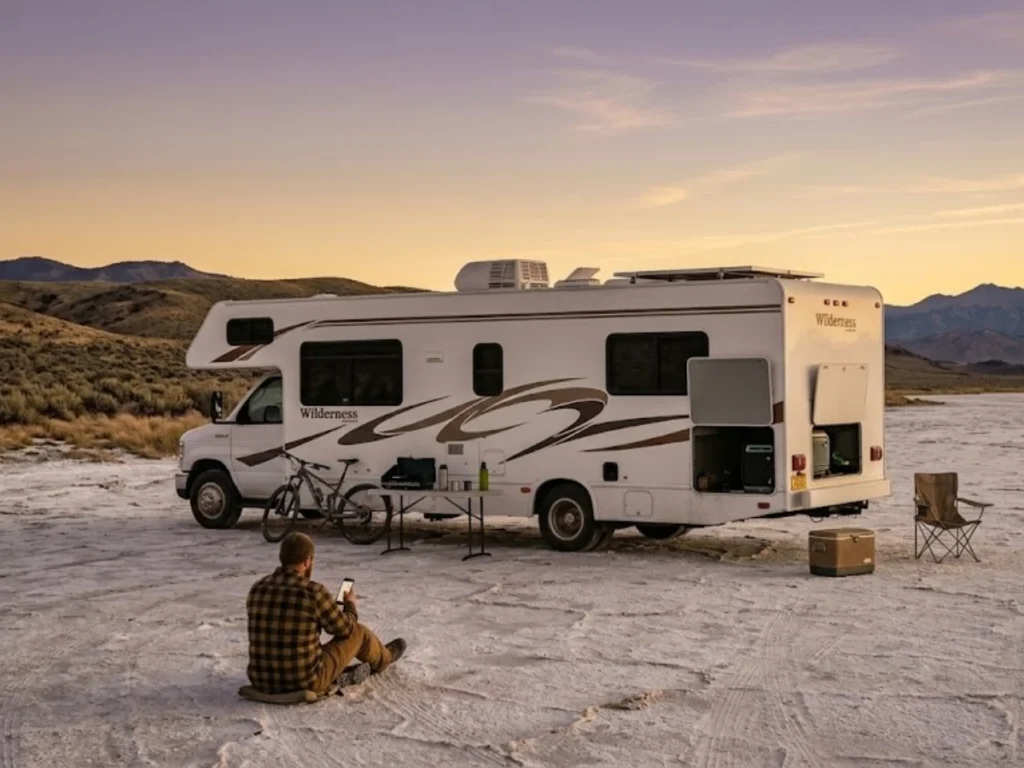
Four things separate a big-rig-capable app from a standard camping app that technically works for any vehicle. First, the ability to input your specific rig dimensions — height, length, weight, and number of axles — so the routing database can flag every road, bridge, and tunnel that conflicts with your profile. Second, real clearance data at the route level, not just the campground level. Low-clearance bridges are the single most dangerous routing hazard for tall rigs — a 13’6″ Class A approaching a 12’8″ bridge is not a planning inconvenience, it is a safety emergency. Third, satellite view access for pre-trip approach evaluation — the ability to see the campground entrance road, the loop geometry, and the pull-through dimensions before you leave home. Fourth, diesel fuel management — finding the cheapest diesel along the route and identifying stations with sufficient canopy clearance for a tall motorhome.
1. AllStays Camp & RV — Best Overall App for Big Rig Trip Planning
AllStays Camp & RV is the most comprehensive single mobile app for big rig travelers, combining overnight stop discovery, route-adjacent filtering, big rig-specific modes, and offline functionality in one database. The AllStays app’s dedicated big rig filter narrows every stop category — campgrounds, KOA locations, truck stops, state parks, national parks, and Walmart parking lots — to only those that explicitly accommodate large rigs. Pull-through site indicators, maximum length listings, and entrance road height clearance notes are included where campgrounds have submitted them.
The satellite view within AllStays is where the app earns its big rig reputation. Before departure, travelers can evaluate the entrance geometry of any listed campground — seeing whether the road is wide enough, whether there is a pull-through available to the check-in building, and whether the campground loop can physically accommodate 45 feet. Experienced big rig drivers check this on every new campground. The AllStays Pro version adds offline maps that function without cellular data, which matters on the rural secondary roads where large rigs most often face unmarked clearance and lane width restrictions.
The app is available on both the App Store and Google Play with a free version covering core stop discovery. Pro is a one-time upgrade with no subscription required.
Best for: Multi-category overnight stop discovery with big-rig-specific filtering, offline use on rural routes, pre-trip satellite approach evaluation Cost: Free base version; one-time Pro upgrade
2. RV Trip Wizard — Best Dedicated Route Planner With Rig Parameters
RV Trip Wizard is purpose-built for big rig route planning in a way that no general navigation app attempts. Travelers input their exact vehicle profile — height, length, gross vehicle weight, and fuel type — and the routing engine identifies every low-clearance bridge, weight-restricted road, and tunnel with propane or diesel fuel restrictions along the planned route before departure. That pre-trip clearance filtering is the specific capability that standard GPS apps on a phone cannot replicate.
For a diesel pusher at 13’6″ and 40,000 pounds loaded, the routing profile eliminates dozens of secondary road shortcuts that would create dangerous approach situations. The fuel planning layer identifies diesel stations along the route with current price data — the cheapest diesel option within a set distance of each planned stop — which matters differently for big rig fuel management than it does for a standard gasoline vehicle. Weigh station locations are also mapped for operators who need to monitor compliance on interstate travel.
RV Trip Wizard integrates with several campground databases and connects to other planning tools, making it the central hub for a complete trip plan rather than a standalone routing app. The website version offers the most complete planning environment; the mobile app provides GPS navigation and turn-by-turn guidance with the big rig profile active during the drive.
Best for: Complete pre-trip routing with rig height/weight/length parameters, bridge clearance and weight restriction avoidance, diesel fuel cost planning on long routes Cost: Subscription-based
3. The Dyrt — Best for Campground Site Research and Rig Restriction Data
The Dyrt is a campground research and review platform that provides two specific features big rig owners need before committing to a reservation. Satellite map overlay allows travelers to evaluate campground layout from above — seeing the entrance road width, loop geometry, and pull-through configuration before arrival. Rig size and age restriction filters narrow the search to campgrounds that actually permit large rigs, filtering out the growing number of private campgrounds that enforce maximum rig age restrictions averaging 13.8 years across the industry.
The nine factors that matter most for RV parking decisions include site length, pad type, and access road clearance — all of which The Dyrt’s community reviews document at the campground level. User reviews from other big rig owners frequently include the specific pull-through dimensions they measured on arrival, whether slideout clearance was adequate, and whether the loop road could actually turn a 45-foot vehicle.
The Dyrt Pro adds sold-out alerts for campgrounds that match a big rig profile filter — useful for the increasingly common scenario where every campground on a route shows full when checked weeks out.
Best for: Pre-trip campground site dimension research, rig size restriction filtering, satellite approach evaluation, same-day opening alerts at big-rig-compatible campgrounds Cost: Free basic version; Dyrt Pro by paid subscription
4. Google Maps — Best for Satellite Approach Evaluation Before Departure
Google Maps is not an RV-specific app, and it has no rig parameter input, no clearance database, and no campground filtering by site length. What it has is satellite and Street View coverage at a resolution that dedicated RV apps rarely match — and experienced big rig drivers use both before every unfamiliar approach.
The workflow is simple: search the campground or parking stop, switch to satellite view, and zoom into the entrance road and campground loop at maximum resolution. Tight turns that would be invisible on a standard map view become obvious from satellite. Entrance canopy heights, overhead power line locations, and the width of the approach road are all visible before departure. Street View along the final mile of approach gives a ground-level perspective that satellite cannot provide.
This pre-trip evaluation process — satellite view and Street View for every new campground before departure — is standard practice among experienced big rig drivers. It takes five minutes and has prevented countless situations where a 45-foot vehicle discovers an impossible turn inside a campground entrance with no room to reverse.
Best for: Pre-trip approach geometry evaluation, entrance road and loop assessment, Street View ground-level perspective on approach roads — used as a planning tool alongside dedicated RV apps, not as a replacement Cost: Free
5. Hookhub — Best for Confirmed Private Land Access for Large Rigs
Hookhub produced this guide. Hookhub is a private land marketplace that connects RV travelers with individual landowners on private property. For big rig owners, the critical feature is what no other platform offers: direct messaging with the host before booking to confirm that the property and access road can actually accommodate your specific rig size.
A 42-foot diesel pusher does not fit in every driveway. A 45-foot fifth wheel needs a specific turning radius to back in without damage. The host communication layer on Hookhub allows the traveler to ask those specific questions — share the rig’s height, length, and turning radius, and receive a confirmed yes or no from a real person who knows their property — before committing to a reservation. No commercial campground booking system offers that pre-booking conversation.
Private land hosts who list on Hookhub and accommodate large rigs typically have rural properties with open approaches, wide gravel driveways, and the kind of pull-through space that commercial campground lots do not provide. For big rig drivers who have been turned away from campgrounds that technically listed their sites as big-rig-compatible, last-minute private land alternatives through Hookhub provide a confirmed fallback option.
Best for: Pre-booking host communication to verify big rig access, private land with open approaches and rural pull-through geometry, confirmed stays without rig size surprises on arrival Cost: No membership fee, pay per stay
6. RV Parky — Best for Big Rig Parking Stop Discovery
RV Parky is a parking-focused discovery app built around finding places for large recreational vehicles to park overnight and during transit stops. The database aggregates truck stops, rest areas, Walmart and chain store lots, and community-contributed overnight spots with stop-level data on dimensions and clearance — information that general campground apps do not prioritize.
For big rig drivers, the parking-first orientation of RV Parky fills the gap between campground apps and navigation apps. A travel day with a 40-foot Class A involves multiple stops — fuel, rest, overnight — each of which requires site geometry that a sedan GPS cannot evaluate. RV Parky’s stop descriptions include user reviews that document whether specific truck stops have adequate space for a large motorhome, whether the canopy clearance at a given fuel stop works for a 13-foot roof, and whether the overnight lot has enough room for slideouts.
The free version provides access to the core stop database. Community contributions update the database with recent conditions at specific stops.
Best for: Transit stop discovery for big rigs — fuel, rest, and overnight stops with dimension data and user reviews beyond what campground-focused apps cover Cost: Free
How They Compare for Big Rigs
| Feature | AllStays | RV Trip Wizard | The Dyrt | Google Maps | Hookhub | RV Parky |
| Rig parameter input (height/weight/length) | Partial — filter only | Yes — full profile | No | No | Via host message | No |
| Bridge clearance routing | No | Yes | No | No | No | No |
| Satellite approach view | Yes | No | Yes | Yes — best | No | No |
| Campground site dimension data | Yes — filtered | Yes — integrated | Yes — strongest | No | Host confirmed | Parking stops |
| Offline maps | Yes — Pro | Yes | Yes — Pro | Yes — download | No | No |
| Diesel fuel management | No | Yes | No | Fuel stations | No | Fuel stops |
| Weigh station mapping | No | Yes | No | No | No | No |
| Host communication before booking | No | No | No | No | Yes | No |
| Private land access for big rigs | No | No | No | No | Yes | No |
| Free version available | Yes | Limited | Yes | Yes | No membership | Yes |
FAQ
What is the biggest routing danger for a 35-45 foot RV?
Bridge clearance is the most dangerous and most commonly overlooked routing risk for tall recreational vehicles. Most major interstate highways maintain clearances above 16 feet, but state routes, county roads, and older underpasses can drop to 12 or 13 feet — below the 13’6″ height of a typical Class A motorhome. Standard GPS apps like Google Maps do not filter routes by vehicle height. RV Trip Wizard is the most capable tool for entering your rig’s exact height and routing around low-clearance structures automatically. Tunnel propane and diesel fuel restrictions on routes through mountain passes are the second category of big-rig-specific routing constraint that standard navigation apps miss.
Can I use AllStays as my main GPS for a big rig road trip?
AllStays is the best app for finding overnight stops, campgrounds, and transit parking for large rigs — but it is a discovery and planning tool, not a turn-by-turn navigation app. Use AllStays to identify and evaluate every stop on your route before departure, then use RV Trip Wizard or a dedicated RV GPS for actual navigation with clearance-aware routing during the drive. The AllStays Pro offline maps are valuable for rural areas with poor cellular coverage, but the app is designed for trip planning rather than in-vehicle GPS guidance. Experienced big rig drivers typically run AllStays and RV Trip Wizard together — discovery layer and routing layer working in parallel.
Do campgrounds at national parks and state parks accommodate 35-45 foot big rigs?
It varies significantly by specific campground and loop. Many developed campgrounds at national parks were built before 40-foot recreational vehicles were standard, and their loop road geometry and site length constraints frequently exclude the largest modern rigs. The Dyrt’s satellite overlay and community reviews from other big rig owners are the best way to evaluate whether a specific national park or state park campground works for your rig size before making a reservation. A campground that lists “RV sites available” may have site lengths of 30 feet and loop turns that a 45-foot fifth wheel cannot complete. Checking the satellite view and reading reviews from owners of similar-length rigs is standard due diligence before any reservation at an older developed campground.
Final Thoughts
The right app stack for a big rig road trip combines at least three tools: RV Trip Wizard for clearance-aware routing before you leave, AllStays or RV Parky for stop discovery along the route, and satellite view for evaluating every new campground approach before you drive in. For private land stays where the host confirms accessibility for your specific rig dimensions before you book, Hookhub provides what no app-based campground database can — a real person who knows their driveway.