A traveling worker can have a solid job assignment and still face a frustrating housing problem. A three-month contract does not fit neatly into a traditional 12-month lease, while hotels can become expensive when the stay stretches from a few nights into several weeks. Corporate housing may offer more space, but it is not always available near the job site or affordable within a worker’s housing budget.
For workers who already travel with an RV, long-term RV housing offers another option.
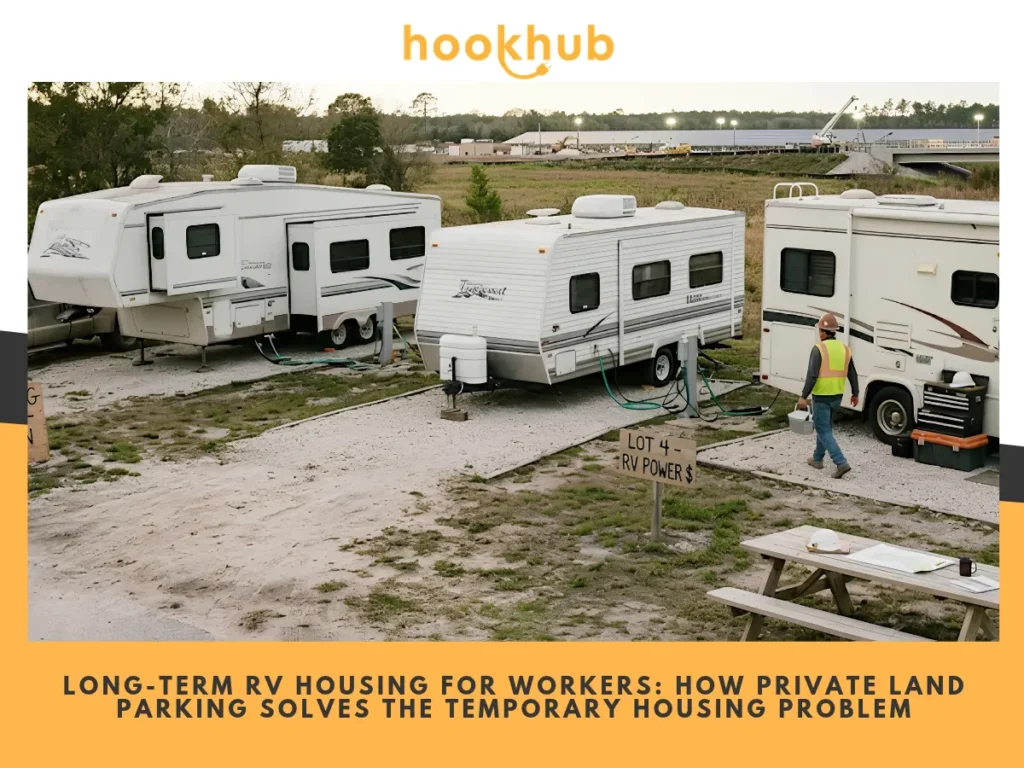
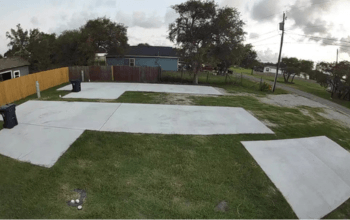
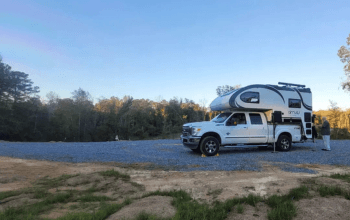
Instead of moving between hotels, short-term rentals, or crowded campgrounds, a worker may be able to secure a monthly RV site on private land and stay in one place for the duration of an assignment. With the right site, that can mean access to water, sewer, electricity, outdoor space, and a more predictable monthly rate.
Private-land RV parking is not the right solution for every worker or every location. Local zoning laws, site availability, utilities, access, and the terms of the stay all matter. But when those pieces line up, a long-term RV site can turn an otherwise difficult temporary-housing problem into a much more manageable one.
Why Traveling Workers Need a Different Kind of Housing
Temporary work assignments create an awkward gap in the housing market.
A traveling nurse might have a 13-week contract. A construction worker could spend several months at a major project. Utility and line workers may relocate temporarily after storms or during large infrastructure projects. Oil and gas workers can spend extended periods away from their permanent homes.
These workers need housing, but they often do not need a permanent home.
That distinction changes what makes a housing option useful. The long-term RV parking shortage can make the search even harder for workers who rely on their RVs as temporary housing, particularly when they need a site for several weeks or months.
A traditional apartment may require a 12-month lease. An extended-stay hotel can offer flexibility but become costly over several months. Short-term vacation rentals can vary significantly in price and availability, particularly near active job sites.
An RV gives a worker another asset to work with.
Instead of finding a completely furnished home every time an assignment changes, the worker can bring the living space with them and look for a suitable place to park it.
That makes long-term RV living particularly relevant for workers whose jobs require frequent relocation.
How Long-Term RV Housing Works for a Work Assignment
Long-term RV housing generally means arranging an RV site for an extended period rather than booking a space for a weekend or a few nights.
Depending on the property, a worker may find:
- Monthly RV sites
- Full hookup sites
- Water and sewer connections
- 30-amp or 50-amp electrical service
- Private outdoor space
- Wi-Fi or strong cellular connectivity
- Parking for a tow vehicle
- Pet-friendly arrangements
- Flexible extension options
The exact setup varies from property to property.
A worker staying for three months has different priorities from someone passing through for three nights. Reliable utilities, reasonable access to the job site, clear rental terms, and a stable place to work or rest can matter more than pools, planned activities, or other traditional campground amenities.
The arrangement may also feel more residential than a typical campground stay. Instead of checking in and out repeatedly, the worker has one place to return to after each shift.
That stability can be especially valuable during physically demanding assignments.
Why Private Land Can Be a Practical Alternative to Traditional Housing
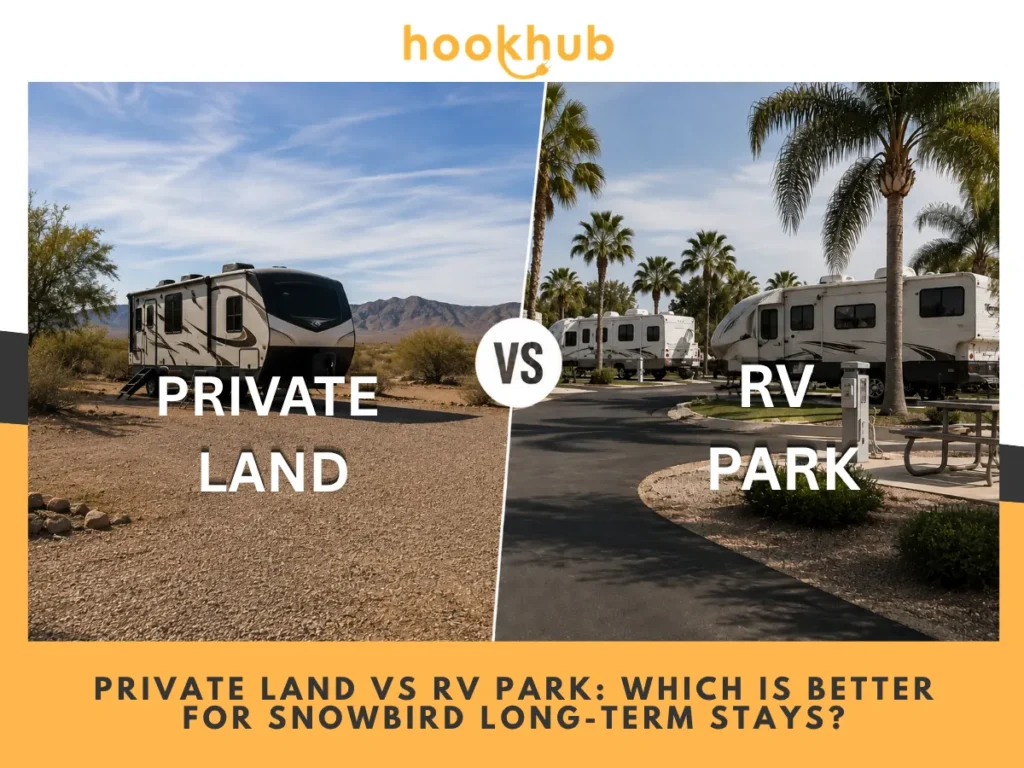
Traditional RV parks and resorts can be excellent choices for long-term stays, but they are not the only option. Parking an RV on private land can provide a different type of experience, particularly for workers who want a quieter site and a more flexible long-term arrangement.
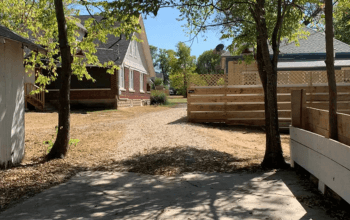
A landowner may have enough space for one or several RV sites without operating a large campground. The property might be rural, semi-rural, or located outside a busy metropolitan area.
For a worker whose priority is a reliable place to stay near a temporary job, that can be a useful alternative.
Private-land parking may also offer a quieter environment than a large campground.
Instead of hundreds of RVs sharing the same property, a worker might stay on a property with only a small number of guests. That can mean fewer distractions after a long shift and more usable outdoor space.
The tradeoff is that private-land sites may have fewer traditional amenities. There may not be a clubhouse, swimming pool, recreation center, or staffed front desk.
For many working renters, that is not necessarily a disadvantage.
The priority is often simple: a legal place to stay, reliable hookups, reasonable access to work, and a monthly arrangement that fits the budget.
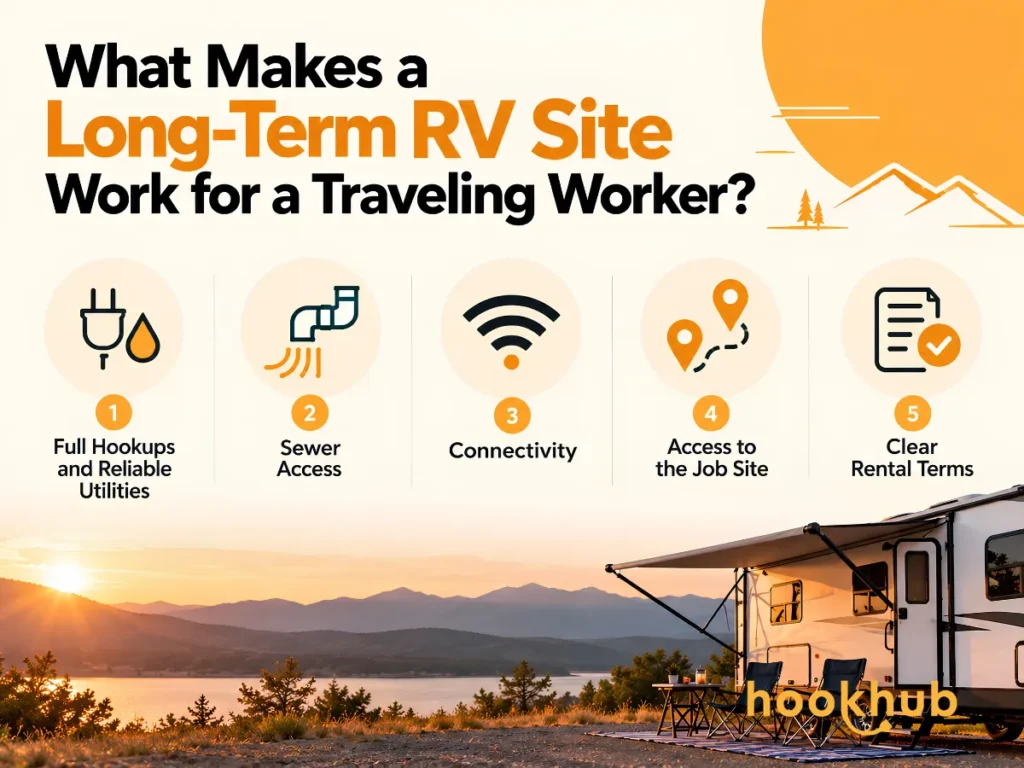
What Makes a Long-Term RV Site Work for a Traveling Worker?
Not every RV site is suitable for an extended work assignment.
Before booking, workers should consider the practical requirements of both their RV and their job.
Full Hookups and Reliable Utilities
Full-hookup RV sites can make a major difference during an extended stay.
A site with water, sewer, and electrical service allows a worker to use the RV more like a stationary home rather than repeatedly moving it to manage basic utilities.
Electrical capacity matters too. Larger RVs may require 50-amp service, particularly when air conditioning, heating, kitchen appliances, and other equipment are being used at the same time.
Workers should confirm the site’s electrical service before booking rather than assuming that every RV site provides the same capacity.
Sewer Access
A sewer hookup becomes considerably more important when an RV is occupied for weeks or months.
A dump station may be sufficient for a short recreational trip, but repeatedly breaking camp to empty tanks is inconvenient during a long work assignment.
If the goal is to live comfortably in the RV for an extended period, confirm whether the site provides a direct sewer connection and whether any additional rules or fees apply.
Connectivity
A reliable internet connection or strong cellular signal can be important even for workers who do not work remotely.
A traveling worker may need to communicate with supervisors, complete paperwork, attend occasional video calls, or simply stay connected with family.
For workers who perform their jobs remotely, connectivity becomes even more important. RV parking for remote workers requires additional attention to Wi-Fi reliability, cellular coverage, workspace, and power availability.
If connectivity is important to the assignment, ask about the actual service available at the site rather than assuming that a rural location has reliable Wi-Fi or cellular coverage.
Access to the Job Site
Distance is only part of the equation.
A site that looks inexpensive can become less attractive if the daily commute adds significant fuel costs and driving time.
Consider the route during actual working hours, not just the distance shown on a map. Construction zones, seasonal traffic, mountain roads, and limited local services can all affect the practicality of a location.
For a worker on a demanding schedule, being reasonably close to work can be worth more than having extra amenities.
Clear Rental Terms
Long-term RV housing should have clear expectations before the stay begins.
Ask about the monthly rate, deposit, utilities, cancellation policy, extension options, guest rules, pets, parking, and any restrictions on the length of occupancy.
A three-month stay is different from a weekend booking, so both the renter and landowner benefit from agreeing on the important details in advance.
How Much Can Long-Term RV Housing Cost?
Cost is one of the biggest reasons workers consider RV housing in the first place, but there is no universal monthly price.
Rates vary by location, season, utility setup, property type, amenities, and demand.
A monthly RV site may cost less than an extended-stay hotel in one market but not necessarily in another. Likewise, a private-land site may be less expensive than a short-term apartment while still requiring the renter to account for RV ownership, insurance, fuel, maintenance, and utilities.
When comparing options, it also helps to understand the difference between monthly vs. nightly RV parking, since the pricing structure can significantly change the overall cost of a longer work assignment.
The useful comparison is therefore not simply:
RV site vs. apartment
Instead, consider the total cost of the housing arrangement for the entire assignment.
That can include:
- Monthly site rent
- Electricity or other utilities
- Internet
- Fuel and commuting
- RV insurance
- Propane
- Maintenance
- Deposits and fees
What a 90-Day RV Housing Budget Might Look Like
Consider a worker who already owns an RV and accepts a three-month assignment. If a monthly site costs $900, the base site cost would be $2,700 for 90 days. Add $125 per month for metered electricity and the total becomes approximately $3,075, before commuting, propane, or other personal expenses.
For comparison, an extended-stay hotel averaging $95 per night would cost $8,550 over the same 90 days before taxes or additional fees. That does not mean an RV site will always be cheaper. Rates vary significantly by market, and RV owners still have insurance, maintenance, fuel, and other ownership costs. But for a worker who already owns an RV, comparing the full 90-day cost rather than the nightly rate can reveal a significant difference between housing options.
For workers who already own an RV and regularly travel for assignments, a monthly site can become a practical part of their existing housing strategy.
For someone who would need to purchase an RV specifically for one short assignment, the calculation is very different.
Who Benefits Most From Long-Term RV Housing?
Long-term RV housing makes the most sense for people whose work already requires mobility, including traveling healthcare workers, construction crews, utility and line workers, contractors, tradespeople, and other workers who follow temporary assignments.
The common factor is not the occupation. It is the need for flexible housing that can move with the worker. For someone staying in one location for years, traditional housing may make more sense. For someone moving between 6-, 12-, or 16-week assignments, bringing the living space with them can solve a very different housing problem.
What a 90-Day RV Work Stay Actually Looks Like
Imagine a construction worker accepting a 12-week assignment outside a growing metro area. He already owns a fifth wheel and needs somewhere to live within a reasonable commute of the project. Instead of searching for a furnished apartment or spending three months in a hotel, he finds a private RV site 15 minutes from the job.
For this renter, the priorities are practical: enough room for the fifth wheel and work truck, 50-amp electricity, water and sewer, reliable cellular service, and a monthly rate he can budget for the entire assignment. A pool or clubhouse may add little value compared with a quiet place to sleep after a long shift and space to park his equipment.
Before booking, he confirms that the property can accommodate the full 12 weeks, asks how electricity is billed, verifies the commute, and finds out whether the stay can be extended if the project runs longer than expected. That is the difference between finding somewhere an RV can park and finding temporary housing that actually works for the job.
Check Local Rules Before You Commit to a Long-Term RV Stay
One of the most important questions is also one that renters sometimes overlook:
Is long-term RV occupancy actually allowed at the property?
The answer can depend on local zoning, county or city regulations, property rules, permits, and the specific circumstances of the stay.
A property owner offering an RV site does not automatically mean that every type of long-term occupancy is permitted.
Some jurisdictions may impose limits on how long an RV can remain on a property. Others may have requirements related to sanitation, utilities, permits, or whether the RV is being used as a primary residence.
That means workers should confirm the rules before making a long-term commitment.
If a job assignment lasts 90 days, for example, a site that only permits a shorter stay may not solve the housing problem after all.
Local compliance should be part of the housing search, not an afterthought.
How to Find Long-Term RV Housing Near a Job Site
Once the basic requirements are clear, the search becomes much easier.
Start with the job location and determine a realistic commuting area. Then narrow potential sites based on the RV’s size, required electrical service, hookups, pets, budget, and expected length of stay.
Look for listings that clearly state whether they accept monthly or extended stays, and start by comparing long-term RV parking near you with the locations available around your work area.
It is also worth asking questions before booking:
- Is the site available for the entire assignment?
- Does the monthly rate include utilities?
- Is there a full sewer hookup?
- What electrical service is available?
- Is Wi-Fi provided?
- Are pets allowed?
- Is the property accessible to the RV and tow vehicle?
- Are there restrictions on occupancy length?
- Can the stay be extended if the assignment continues?
- What happens if the work assignment ends early?
Getting clear answers upfront can prevent expensive surprises later.
For workers, the goal is not simply to find an RV site.
It is to find a site that works for the entire assignment.
Where Hookhub Fits Into Long-Term RV Housing for Workers
Hookhub can help workers approach the search from the requirements that actually matter for an extended stay.
Instead of treating every RV site as interchangeable, renters can look for private-land options that fit their needs around location, hookups, monthly availability, and the length of the assignment.
That can be particularly useful for workers who already know their job location and approximate stay dates but do not want to commit to a traditional lease.
Private-land inventory will naturally vary by market. In some areas, a traditional RV park may offer more availability. In others, a private-land site may provide a quieter location or a better fit for the worker’s specific requirements.
The point is not that one type of housing works everywhere.
It is that workers now have another option to evaluate when traditional temporary housing does not fit.
“I lived the problem. I felt the panic of losing a place to stay. Hookhub exists because people deserve better options than that.”
Frequently Asked Questions
Is long-term RV housing a good option for traveling workers?
It can be, particularly for workers whose assignments last several weeks or months and who already own an RV. The biggest advantages can include flexibility, predictable site arrangements, and avoiding a traditional long-term lease.
Can you live in an RV on private land long-term?
It depends on local regulations and the property’s permitted use. County and city zoning rules may limit RV occupancy or require permits, so renters should confirm the rules before booking an extended stay.
What should a worker look for in a monthly RV site?
Start with the basics: legal occupancy, reliable utilities, full hookups, adequate electrical service, connectivity, reasonable access to the job site, and clear rental terms. RV size, pets, parking, and extension policies may also matter.
Are private-land RV sites cheaper than hotels?
They can be, particularly for stays lasting several weeks or months, but prices vary significantly by location. Workers should compare the total cost of the RV arrangement, including site rent, utilities, commuting, insurance, and other expenses.
Can RV workers stay for three months or longer?
Some properties offer extended or monthly stays, but the permitted length depends on the property and local regulations. Always confirm both the listing’s terms and applicable occupancy rules before committing.
Final Thoughts
Temporary work does not always fit neatly into traditional housing.
A worker may need somewhere to live for six weeks, three months, or an entire project without wanting to sign a year-long lease or spend the entire assignment in a hotel. For RV owners, long-term RV housing can provide another way to approach that problem.
A monthly private-land site can offer the stability of staying in one place while keeping the flexibility that comes with RV living.
The key is choosing the site carefully.
Check the local rules. Confirm the hookups. Consider the commute. Understand the monthly rate and rental terms. Make sure the property works for the RV and the length of the assignment.
When those pieces line up, a private-land RV site can become more than a place to park. It can become a practical temporary housing solution for the duration of the job.
Browse long-term RV parking on Hookhub and compare available options near your work location.