
Key Takeaways
- Roadtrippers is a route planning and discovery app — it maps your journey, surfaces points of interest, and estimates fuel costs before you leave home.
- Hookhub is a private land marketplace — it connects RV travelers with individual landowners who offer confirmed parking, extended stays, and storage.
- Roadtrippers does not process confirmed RV parking reservations on private property.
- Hookhub does not plan routes, surface attractions, or estimate drive times
- The two tools address different problems on the same trip and are used together by many experienced travelers.
- Choosing between them is the wrong question — understanding what each one solves is the right one.
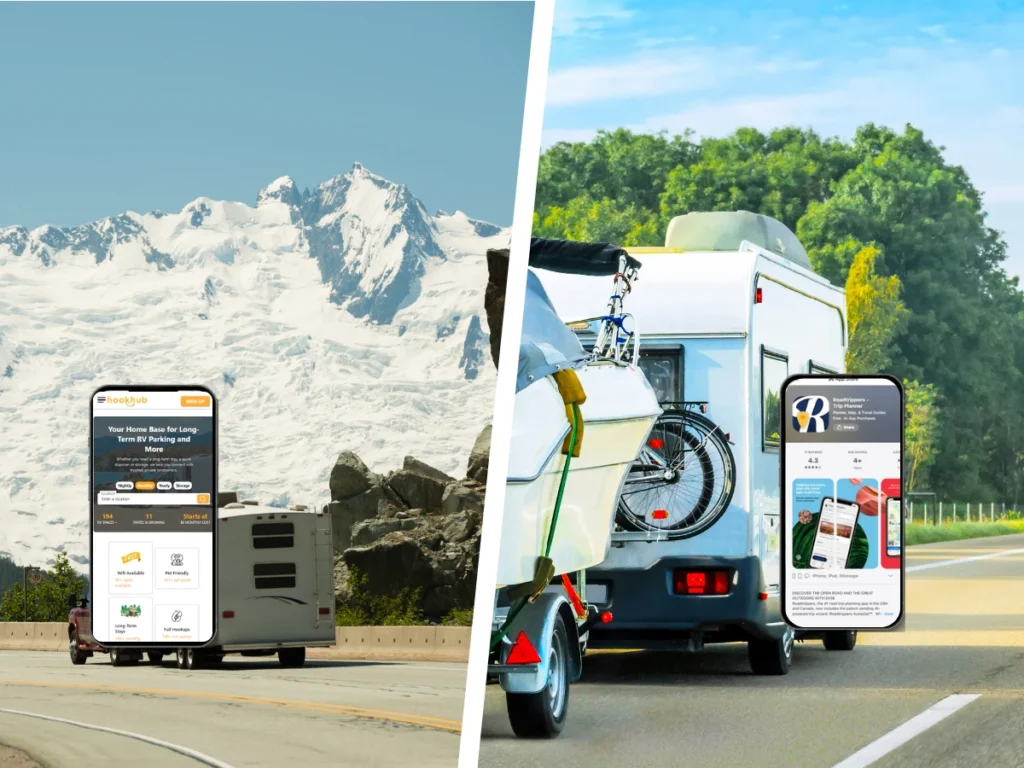
How Do They Compare?
| Feature | Hookhub | Roadtrippers |
| Private land booking | Yes — confirmed stays | No |
| Route planning and mapping | No | Yes |
| Points of interest discovery | No | 5 million+ POIs |
| RV-specific GPS navigation | No | Yes, with hazard warnings |
| Gas cost estimator | No | Yes |
| Campground database | Private land only | 50,000+ commercial campgrounds |
| Free overnight parking locator | No | 16,000+ locations |
| Offline maps | No | Yes — Premium |
| Collaborative trip planning | No | Yes |
| Public land overlays | No | Yes |
| Host communication before booking | Yes — direct messaging | No |
| Monthly and long-term stays | Yes — host-set rates | No |
| Free insurance on stays | Yes | No |
| Annual fee required | No | No / $29.99 Premium |
| US and Canada coverage | US only | US and Canada |
| Mobile app | Yes — iOS and Android | Yes — iOS and Android |
Nearly 4 in 10 leisure travelers plan to take an RV trip in 2026, according to Go RVing’s Year in Search data published by the RVIA. That number reflects a lifestyle shift that has been building for years, driven by remote work flexibility, rising interest in outdoor recreation, and a growing community of people who document their time on the road across social media with tags like #rvlife and #rving.
When travelers in that community go looking for tools, two names consistently surface in the same conversations: Roadtrippers for planning the route, and Hookhub for securing private land stays along the way. They appear together because they solve different parts of the same problem. This comparison explains exactly where each one starts and stops.
What Does Roadtrippers Actually Do?
Roadtrippers is the most widely used road trip planning app in the US, built around the idea that getting from one place to another is only part of what makes a journey worth taking. The platform maps start and end points, then populates the route with over 5 million points of interest — national parks, scenic byways, roadside attractions, local diners, campgrounds, and destinations that do not appear on a standard navigation app.
For RV travelers specifically, Roadtrippers added meaningful features after acquiring Campendium: RV-specific GPS routing that avoids low bridges and roads with weight restrictions, overlays for public land and cell coverage, a gas cost estimator calibrated to your rig, and a database of over 50,000 campgrounds filterable by hookups, dump stations, and pet policies. The AI Autopilot feature, built on data from 38 million planned trips, generates personalized itineraries based on your stated travel preferences.
The free version caps trips at seven waypoints. The Premium plan at around $29.99 per year unlocks up to 150 stops, offline maps, live traffic, and collaborative planning tools that let family members or travel partners add their own stops to a shared itinerary in real time.
What Roadtrippers does not do: confirm a private land parking reservation, connect you with an individual landowner, or process a booking for a stay that happens outside the commercial campground network. It can show you that a campground exists near a point of interest. It cannot confirm that a private landowner is expecting you, that your rig fits the space, or that the terms of your stay are settled before you arrive.
What Does Hookhub Do?
Hookhub produced this guide. Hookhub is a private land marketplace where landowners — ranchers, farmers, and rural property owners — list available space for RV parking, extended stays, and long-term storage. Travelers search listings by location, filter by amenities, and book confirmed stays directly through the platform. Each booking includes free insurance, renter vetting, and host damage protection. The host is expecting you. The terms are settled before you arrive.
Parking an RV on private land through Hookhub is a fundamentally different experience from pulling into a commercial campground. Private hosts set their own per-night and monthly rates. There is no annual membership fee. You pay for the stays you book. For travelers who have spent time in the #rvhosting community and understand the difference between a managed park and a private rural property, the distinction is the entire point.
What Hookhub does not do: plan a route, estimate drive time, surface roadside attractions, or suggest where to stop for fuel. It is a booking and marketplace platform, not a trip planner. Travelers who arrive at Hookhub already know roughly where they are going — they need a confirmed spot, not a discovery engine.
Where the Gap Shows Up in Practice
The RVshare 2026 Travel Trend Report found that 87% of travelers prefer RV accommodations when visiting national parks, and that flexibility has become the primary driver of trip planning decisions. That combination — destination-led travel with high flexibility expectations — is exactly the scenario where the gap between a planning tool and a booking platform becomes most visible.
A traveler building a two-week route through the American Southwest in Roadtrippers can identify every national park stop, every scenic byway, every fuel station, and every campground within a set distance of the route. What Roadtrippers cannot tell is whether a private landowner near the Coronado Trail has space for a 40-foot fifth wheel at the end of the third driving day, whether that host allows late arrivals, or whether the monthly rate makes sense if the trip extends.
That is the moment finding last-minute or confirmed parking on private land becomes the next step after route planning — not a replacement for it. Roadtrippers builds the map. Hookhub fills in the confirmed overnight spots that are not in any commercial database.
When to Use Each One
Use Roadtrippers when you are building a multi-stop road trip and want to discover what falls along the route — which parks, which towns, which campgrounds, which scenic detours. Roadtrippers earns its value in the planning phase, weeks or days before departure, when the journey is still a map rather than a drive.
Use Hookhub when you need a confirmed private land spot for a specific night, a weekend, or a three-month snowbird arrangement. Long-term private land parking is where host-set pricing and direct booking architecture outperform what any trip-planning tool can offer. No route planner arranges a confirmed stay with a real landowner. Hookhub does.
Use both when the route is planned, and the overnight spots need to be locked in. Many experienced travelers build the itinerary in Roadtrippers, then search Hookhub for private land near each major stop — particularly in regions where commercial campgrounds are expensive, full, or simply the wrong environment for a longer stay.
Does the RV Hosting Community Use Both?
Yes. The RV hosting conversation on platforms like Facebook and Instagram — under tags like #Hookhubrv and #passiveincome — reflects a community that understands the distinction between planning tools and booking platforms because they operate on both sides. Hosts who list their land on Hookhub are the same people who plan their own road trips. Guests who book private land stays often arrive at a region because Roadtrippers surfaced it as worth visiting.
The community angle matters because it reflects genuine behavior: travelers who care deeply about where they sleep at night, and hosts who opened their land to guests because they believe private property offers a better experience than a commercial park row. Neither group confuses a trip planner with a booking platform.
FAQ
Can Roadtrippers book a private land RV stay?
No. Roadtrippers surfaces campgrounds from its database and links to booking options at commercial properties, but it does not connect travelers with private landowners or process confirmed stays on private property. The private land booking category belongs to platforms purpose-built for it, where a host-guest relationship is established before the stay begins, and terms are agreed in advance.
Does Hookhub help me plan a road trip route?
No. Hookhub is a booking marketplace, not a journey planner. Travelers who want to build a multi-stop route with estimated drive times, fuel costs, and points of interest along the way need a dedicated planning tool. Hookhub’s value starts where the route is already decided — when the traveler knows the region and needs a confirmed, host-vetted space to park.
Is Roadtrippers Premium worth it for RV travelers?
For travelers who take more than one multi-stop road trip per year, the Premium tier at around $29.99 annually pays for itself quickly through offline maps alone. The RV-specific routing features, which alert drivers to low clearances, propane restrictions, and weight limits, add meaningful safety value for anyone in a large recreational vehicle. The campground discovery and free overnight parking locator features further extend the value for budget-focused travelers who want to reduce per-night costs along a long route.
Roadtrippers plans the adventure. Hookhub confirms where you park. A traveler who understands that distinction is already ahead of most of the crowd searching for a single tool that does both.
Find confirmed private RV parking near you and see what hosts are available on your route.