
Every winter, a quiet migration reshapes Arizona.
Thousands of RVers leave colder states and move into the Phoenix metro, Scottsdale, Mesa, and surrounding desert areas. They are not passing through. They are staying.
For 30, 60, sometimes 90 nights.
And increasingly, they are not choosing traditional RV parks.
They are choosing private land.
Not because it is cheaper. Because it is quieter, less crowded, and more predictable for long-term living.
This shift has created a very specific opportunity:
Arizona landowners are earning $3,000 to $6,000+ per month by hosting a small number of RVs on their property during snowbird season without building a campground.
But that income is not accidental. It comes from understanding:
- What long-term RV guests actually need
- How to structure sites for monthly stays
- How utilities and pricing work in Arizona
- How to avoid common hosting mistakes
This guide breaks that down clearly.
Why Snowbird Season Drives Demand for Long-Term RV Hosting
Snowbird demand is not just “more travelers.”
It is predictable, seasonal, long-term demand.
From November through March, Arizona becomes one of the highest-demand RV markets in the country.
Why Arizona Specifically
- Daytime winter temperatures: 65–80°F
- Minimal precipitation
- Strong road infrastructure
- High concentration of services (healthcare, retail, golf, recreation)
But the key shift is this:
Traditional RV parks are often full months in advance.
And even when available, they come with:
- High density (100–300 sites)
- Noise
- Limited flexibility
- Rigid booking windows
So snowbirds increasingly look for:
- Private land
- Lower density
- Flexible monthly arrangements
- Less turnover around them
That is where landowners step in.
What $5,000+/Month Actually Looks Like (Real Breakdown)
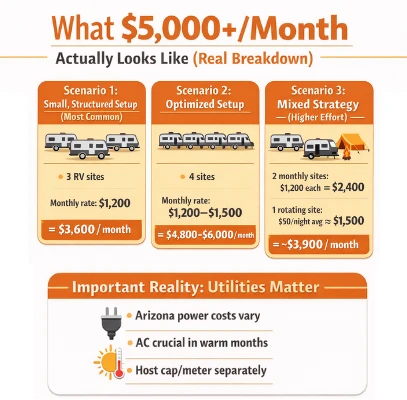
The headline number is possible, but it depends on structure.
Let’s break it down realistically.
Scenario 1: Small, Structured Setup (Most Common)
3 RV sites
Monthly rate: $1,200
= $3,600/month
Minimal turnover
Lower management
Scenario 2: Optimized Setup
4 sites
Monthly rate: $1,200–$1,500
= $4,800–$6,000/month
This is where many Arizona landowners land.
Scenario 3: Mixed Strategy (Higher Effort)
2 monthly sites ($1,200 each) = $2,400
- 1 rotating site ($50/night avg) = ~$1,500
= ~$3,900/month
More management
More variability
Important Reality: Utilities Matter
In Arizona, power is not a small detail.
During winter, usage is moderate.
During shoulder seasons or warmer months:
- AC usage increases
- Electric costs can spike
This is why many hosts either:
- Include utilities with a cap
- Or meter electricity separately
Ignoring this leads to profit erosion.
Why Private Land Outperforms RV Parks for Snowbirds
This is the core positioning advantage.
Snowbirds are not looking for a vacation.
They are looking for a temporary home base.
Private land offers:
Lower Density
Instead of 150 sites:
- 2–5 sites
- More space between rigs
- Less noise
Predictability
- No rotating weekend campers
- Stable neighbors
- Consistent environment
Flexibility
- Easier extensions
- Negotiated monthly terms
- Less rigid rules
Real Scenario
A couple staying 60 nights will often choose:
- A quiet 3-site property outside Scottsdale over
- A crowded resort with constant turnover
- Even at similar pricing.
What You Actually Need to Start Hosting (Long-Term Focus)
You do not need to build a campground.
But you do need to meet baseline expectations for daily living, not camping.
Download the Arizona RV Hosting Playbook to see the exact setup, utilities, and pricing approach that works best for snowbird season.
Land Requirements (Practical, Not Idealized)
Your property should support:
- Straightforward access (no tight turns)
- At least one 60–75 ft usable space
- Stable ground (gravel or compacted soil)
- Clear entry and exit path
Properties in:
- Queen Creek
- San Tan Valley
- Cave Creek
- Outskirts of Scottsdale
are often ideal because they balance space with proximity.
Utilities: What Actually Matters for Monthly Stays
Electricity (Critical)
50 amp is strongly preferred.
Why:
- Two AC units
- Daily appliance use
- Long-term comfort
30 amp limits your guest pool significantly in Arizona.
Water
- Must be potable or clearly labeled
- Stable pressure
- Reliable source
Sewer
Options:
- Full hookup at site (best)
- Septic access
- Scheduled dump plan
For 30+ day stays:
No sewer = lower retention and lower rates
Infrastructure Reality
You can start simple.
Many landowners begin with:
- 1–2 sites
- Power + water
- No sewer initially
Then upgrade based on demand.
Permits, Zoning, and Arizona Considerations
Arizona is generally favorable for private land use, but:
- County rules vary
- Some areas restrict multiple units
- HOA rules (especially in Scottsdale areas) can override everything
You must verify:
- Long-term RV occupancy rules
- Utility installation requirements
- Septic capacity
Skipping this step creates long-term risk.
Amenities That Actually Increase Monthly Bookings
For long-term guests, amenities are about livability, not entertainment.
High-Impact Amenities
- 50 amp power
- Level gravel pad
- Shade (critical in Arizona)
- Trash solution
- Quiet environment
Secondary (But Valuable)
- WiFi or known strong signal
- Defined outdoor space
- Basic seating
What Matters Less Than You Think
- Fire pits
- “Campground-style” extras
- Recreational features
Long-term guests prioritize stability over novelty.
Where Hookhub Fits Into This Model
The challenge for most landowners is not the land.
It is the structure.
Without structure, common issues appear:
- Unclear pricing
- Guest disputes
- No-show risk
- Payment problems
- No vetting
Platforms like Hookhub provide:
- Listing visibility for long-term RV stays
- Structured booking and payment handling
- Guest vetting
- Baseline protection and consistency
This allows landowners to focus on:
- Their property
- Their setup
- Their guest experience
Instead of building systems from scratch.
Making Your RV Hosting Setup Profitable (Beyond the First Month)
Profitability is not just about filling sites once.
It is about consistency.
What Drives Long-Term Profit
- Stable monthly guests
- Clear policies
- Utility management
- Repeat or extended stays
Common Mistakes That Reduce Income
- Underpricing monthly rates
- Including unlimited electricity without planning
- Accepting difficult guests without screening
- Poor site layout causing conflicts
Simple Optimization Path
Start with:
1–2 sites → validate demand → improve utilities → expand
Do not overbuild before demand is proven.
Managing RV Hosting Beyond Snowbird Season
Winter is peak.
But your property does not need to sit idle the rest of the year.
You can attract:
- Traveling professionals
- Short-term relocations
- Shoulder-season travelers
However, Arizona summer introduces:
- Extreme heat (110°F+)
- Higher power usage
- Lower demand
Some hosts:
- Reduce pricing
- Shift to shorter stays
- Pause entirely
Seasonality should be planned, not reacted to.
Key Takeaways
- Arizona snowbird season creates predictable demand for long-term RV stays
- Private land performs well because it offers space, quiet, and flexibility
- $5,000+/month is achievable with 3–4 well-structured sites
- Utilities, especially electricity, directly impact profitability
- Monthly hosting requires more structure than short-term camping
- Platforms like Hookhub help simplify booking, guest management, and operational clarity
- Long-term success comes from consistency, not one-time bookings
Conclusion
Arizona’s snowbird season is not just a travel trend.
It is a predictable, recurring demand cycle.
Landowners who understand how to structure their property for long-term RV stays can participate in that cycle without building a traditional RV park.
You do not need:
- 50 sites
- Resort amenities
- Large-scale infrastructure
You need:
- Reliable utilities
- Clear expectations
- A well-prepared site
When those elements are in place, unused land becomes a consistent income-producing asset during one of the strongest seasonal RV markets in the country.
Download the Arizona RV Hosting Playbook and get a clear checklist for setting up 1–4 long-term sites for snowbirds.
It’ll help you avoid the most common AZ hosting mistakes with util