

Running a ranch in Arizona today looks very different than it did even ten years ago.
Between drought pressure, rising feed costs, and tighter beef margins, many ranchers are realizing that relying on cattle alone is no longer enough to create stable income. In areas near Phoenix and Tucson, land values have increased significantly, but traditional ranch revenue has not kept pace.
That gap is forcing a shift.
Instead of expanding herd size, more ranch owners are asking a different question:
How can this land produce income beyond livestock?
This is the story of one Arizona rancher who did exactly that—turning underutilized acreage into approximately $60,000 per year by layering multiple income streams, including long-term RV hosting, without increasing livestock risk.
Key Takeaways
- That’s why more Arizona ranch owners are shifting toward diversified land use instead of expanding herd size.
- Unused or underutilized acreage can generate meaningful income without increasing herd size
- Long-term RV hosting (30–90 nights) is one of the highest-leverage income layers near Phoenix and Tucson
- Infrastructure matters more than amenities when it comes to consistent bookings
- The most successful ranchers are stacking income streams, not relying on one
Download the Arizona RV Hosting Playbook to see the exact setup, utilities, and pricing approach that works best..
Why Traditional Ranching Alone Is Becoming Risky
For many ranchers across Arizona and the broader Southwest, the challenges are compounding.
This rancher was running a fairly typical cattle operation:
- grazing management
- herd health
- seasonal calf production
But the economics were tightening:
- Drought reduced usable grazing land
- Feed and water costs continued rising
- Beef margins remained inconsistent
- Seasonal volatility made planning difficult
The ranch wasn’t failing.
But it wasn’t stable.
The key shift came when the rancher stopped asking:
“How do I grow my herd?”
…and started asking:
“How else can this land produce income?”
The Property: 200 Acres Near Phoenix With Untapped Value
This was not a large commercial operation.
It was a 200-acre ranch within driving distance of Phoenix, which turned out to be one of the most important factors.
That proximity created built-in demand:
- snowbirds looking for winter stays
- remote workers needing space
- RVers avoiding crowded parks
- people seeking privacy near urban areas
The land already had:
- open rangeland
- basic fencing
- a barn
- accessible terrain
- strong desert views
Nothing about the land changed.
Only how it was used changed.
How Ranchers in Arizona Are Actually Making Money Today
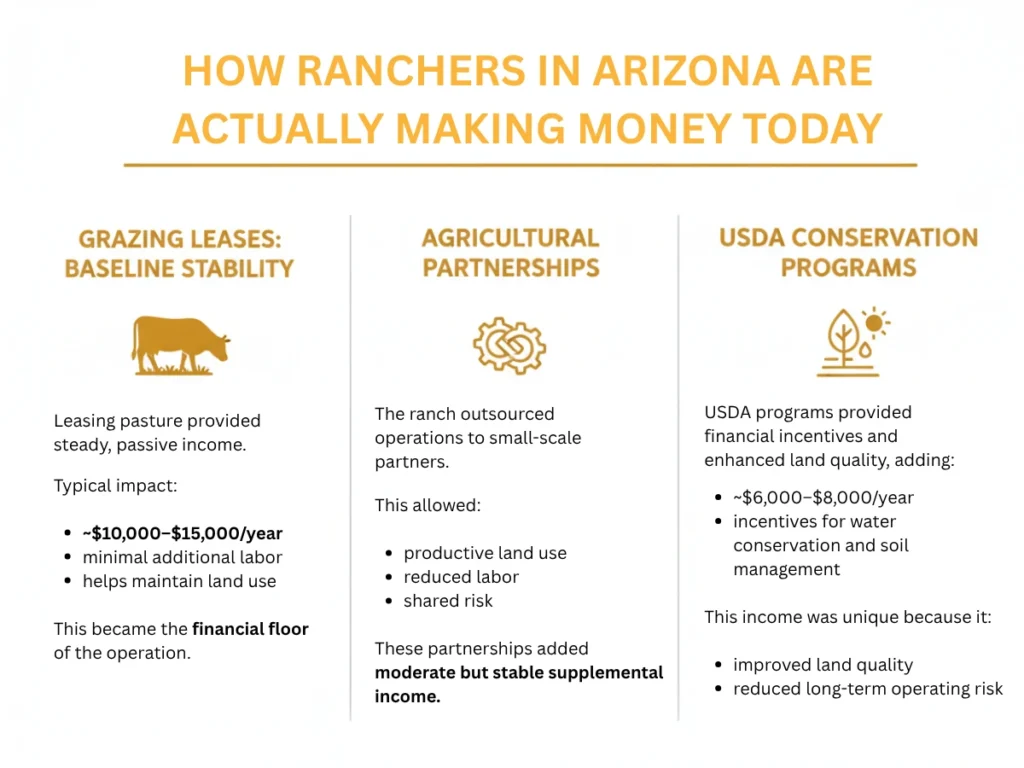
Modern ranch income is not built on a single stream.
It is built by layering:
Grazing Leases: Baseline Stability
Leasing pasture to other operators created consistent, low-effort income.
Typical impact:
- ~$10,000–$15,000/year
- minimal additional labor
- helps maintain land use
This became the financial floor of the operation.
Agricultural Partnerships
Instead of operating everything directly, the ranch partnered with small-scale operators.
This allowed:
- productive land use
- reduced labor
- shared risk
These partnerships added moderate but stable supplemental income.
USDA Conservation Programs
Programs supported by the USDA can provide financial incentives while improving land quality. Participation in USDA-backed programs added:
- ~$6,000–$8,000/year
- incentives for water conservation and soil management
This income was unique because it:
- improved land quality
- reduced long-term operating risk
The Real Shift: Turning Land Into an Income-Producing Asset
The largest income jump did not come from agriculture.
It came from using the land differently.
Instead of treating the ranch purely as a production asset, it became a space people would pay to use.
Ranch Stays and Long-Term RV Hosting
This is where the model changed.
Demand for rural, long-term RV stays in Arizona has grown significantly, especially near Phoenix and Tucson.
But this is where many landowners misunderstand the opportunity.
This is not:
👉 weekend camping
👉 overnight stays
This is:
👉 30–90 day stays
👉 seasonal setups (snowbirds)
👉 temporary living arrangements
And that difference changes everything.
Download the Arizona RV Hosting Playbook to see the safest setup approach for long-term stays (site count, utilities, and how to avoid the most common compliance mistakes).
Many landowners use platforms like Hookhub to reduce these risks by setting clear expectations, managing bookings, and standardizing how guests use the property.
This turns what could be a messy process into something more structured and predictable.
What It Actually Takes to Host RVs on a Ranch in Arizona
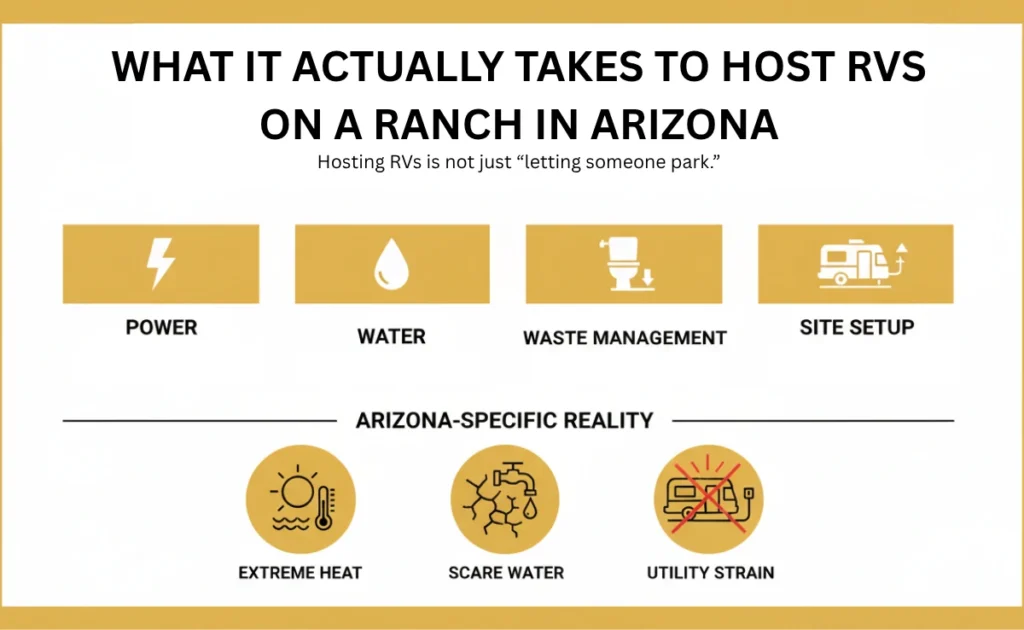
Hosting RVs is not just “letting someone park.”
For long-term stays, the requirements are operational, not cosmetic.
At minimum:
Power
- 30 amp works
- 50 amp is strongly preferred in Arizona
Why:
- Summer heat exceeds 110°F
- RVs rely heavily on AC
- Weak electrical setups fail quickly
Water
- Consistent and reliable
- Higher usage during long stays
Waste Management
- Septic or dump access
- Must handle sustained usage
Site Setup
- Level ground
- Accessible entry roads
- Enough space for maneuvering
Arizona-Specific Reality
Arizona changes the equation:
- Heat increases power demand
- Water usage is higher than most states
- Long-term guests expose weak infrastructure
If utilities are not stable:
👉 hosting becomes a liability, not income
Real Cost and Income Breakdown (How the Ranch Reached ~$60,000)
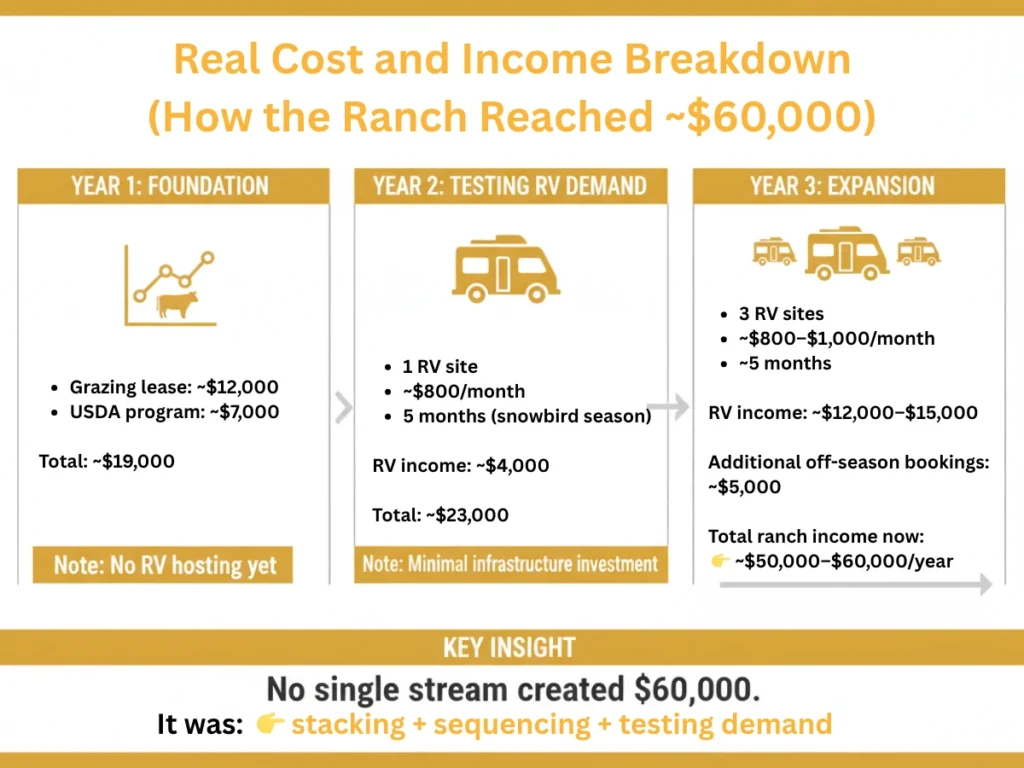
This income was not immediate.
It was built over time.
Year 1: Foundation
- Grazing lease: ~$12,000
- USDA program: ~$7,000
Total: ~$19,000
No RV hosting yet.
Year 2: Testing RV Demand
- 1 RV site
- ~$800/month
- 5 months (snowbird season)
RV income: ~$4,000
Total: ~$23,000
Minimal infrastructure investment.
Year 3: Expansion
- 3 RV sites
- ~$800–$1,000/month
- ~5 months
RV income: ~$12,000–$15,000
Additional off-season bookings: ~$5,000
Total ranch income now:
👉 ~$50,000–$60,000/year
Key Insight
No single stream created $60,000.
It was:
👉 stacking + sequencing + testing demand
What Can Go Wrong (And Why Most Ranchers Fail Here)
This is where most articles stay surface-level.
This is also where most failures happen.
Common Problems
- Electrical systems overloaded during peak heat
- Septic systems not designed for long-term use
- Zoning violations discovered too late
- Guests misunderstanding expectations
- Pricing too low (attracting poor-fit renters)
Real Scenario
One early guest stayed longer than expected.
Issues that came up:
- higher-than-expected power usage
- unclear water expectations
- access misunderstandings
None of these were major.
But together:
👉 they created friction
This is where structure becomes critical.
Where Hookhub Fits Into Ranch Income Strategy
As ranch owners begin layering income streams, managing bookings, expectations, and land use can quickly become complex.
This is where platforms like Hookhub become useful, not as a business model, but as a structure for managing RV hosting on private land.
Instead of handling everything manually, ranchers can use it to:
- Standardize guest expectations for long-term stays (30–90 days)
- Clarify access to utilities like water, power, and septic
- Reduce misunderstandings that often lead to disputes
- Keep bookings organized without building a full campground system
For many Arizona ranch owners, especially those near Phoenix or Tucson, this creates a way to test RV hosting as an income stream without overbuilding infrastructure too early.
The key is not the platform itself, but the structure it provides.
What That Actually Means
Instead of handling everything manually, ranchers can:
- Set clear expectations for long-term stays (30–90 days)
- Define utility usage upfront
- Avoid misunderstandings before arrival
- Keep bookings organized without building systems
This becomes more important as stays get longer.
Because:
👉 small misunderstandings over 60–90 days become big problems
Sustainable Ranching That Increases Profit
Profitability in Arizona is tied directly to sustainability.
Water Management
Poor planning here leads to:
- rising costs
- operational instability
Water systems must be efficient and reliable. Poor planning here leads to higher costs and operational issues quickly.
Arizona water planning plays a major role in long-term ranch viability.
Solar Energy
Solar reduces:
- long-term energy costs
- RV hosting expenses
It also improves scalability. Solar helps reduce long-term energy costs and supports both ranch operations and RV hosting setups.
Regenerative Grazing
Improves:
- land quality
- livestock output
- long-term sustainability
Practical Steps to Start
If you want to replicate this model:
Start small.
Step 1: Evaluate Your Land
- unused acreage
- accessibility
- proximity to demand (Phoenix, Tucson, etc.)
Step 2: Check Regulations
- zoning
- county rules
- utility requirements
Step 3: Start With ONE Income Stream
Not five.
- grazing lease
- or 1 RV site
Step 4: Test Before Expanding
- validate demand
- refine setup
- fix issues early
Step 5: Scale Gradually
- add sites
- improve utilities
- increase pricing
Conclusion
The ranchers who are succeeding today are the ones who understand how to use their land strategically, not just traditionally.
They are using their land differently.
By combining:
- traditional agriculture
- conservation programs
- and long-term RV hosting
they are turning static land into a flexible, income-producing asset.
The opportunity is not in building a campground.
It is in understanding:
👉 what your land can already support
👉 and building from there
By combining agriculture, land access, and experience-based use, a ranch becomes more than a working operation. It becomes a flexible, income-generating asset that can adapt to Arizona’s climate and market conditions.
Download the Arizona RV Hosting Playbook and get a clear checklist for setting up 1–4 long-term RV sites, especially for snowbird demand. It’ll help you avoid the most common AZ hosting mistakes with utilities, pricing, and guest fit.
FAQ
What are the best ways to make money on a ranch in Arizona?
Grazing leases, agricultural partnerships, conservation programs, and long-term RV hosting are among the most effective strategies.
Can unused ranch land generate income?
Yes. Even small portions of land can generate revenue through leasing or RV hosting when used strategically.
Is RV hosting profitable in Arizona?
Yes, especially near Phoenix and Tucson where demand for long-term stays is strong during snowbird season.
Do you need a large ranch to start?
No. Many landowners begin with one RV site or a small lease and expand over time.