Many retirees spend decades working toward financial security, only to find that retirement income doesn’t always stretch as far as expected. Property taxes continue to rise, maintenance costs never seem to disappear, and unexpected expenses can quickly disrupt even the most carefully planned budget.
At the same time, millions of RV travelers are searching for private places to stay. According to the RV Industry Association, RV ownership and travel demand continue to grow across the United States.
Traditional RV parks remain popular, but many travelers now prefer quieter, more private locations where they can enjoy space, flexibility, and a more personal experience.
For retiree landowners, that creates an opportunity.
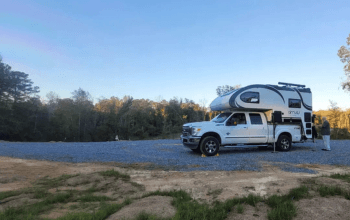
If you own unused acreage, a large backyard, a farm, ranch, homestead, or rural property, RV hosting can provide a practical way to generate income from land you already own. You don’t need to build a campground, invest in expensive amenities, or turn hosting into a full-time job. Many successful hosts start with little more than a safe, accessible place to park.
This guide explains how RV hosting works, what kind of income retirees can realistically expect, what financial and tax considerations matter most, and how to determine whether hosting is the right fit for your property and retirement goals.
Why More Retirees Are Looking at RV Hosting
Retirement often changes how people think about their property.
Land that once served a specific purpose may no longer be fully utilized. Children move away. Agricultural operations slow down. Large sections of property remain untouched for months at a time.
Meanwhile, the financial reality of retirement creates new priorities. Many retirees are interested in generating supplemental income without taking on another traditional job. They want flexibility, control, and something that fits their lifestyle.
RV hosting checks many of those boxes.
Recent findings from the North American Camping Report also show continued demand for camping and outdoor travel experiences, supporting long-term interest in private RV accommodations.
Unlike starting a business that requires inventory, employees, or daily operations, hosting allows landowners to generate income from an asset they already own. In many cases, the land itself is the primary resource.
This approach appeals to retirees because it can be scaled to fit individual goals. Some hosts accept only occasional weekend travelers. Others focus on monthly guests seeking a quiet place to stay. Some open only during peak seasons when demand is highest.
The result is a flexible income opportunity that allows landowners to remain in control of how much or how little they participate.
What Is RV Hosting?
RV hosting involves allowing RV travelers to stay on private property in exchange for payment.
Guests may stay overnight, for several days, or for extended monthly periods depending on the property and the host’s preferences.
Contrary to what many new hosts assume, RV hosting is not the same as operating a campground.
You don’t need dozens of sites.
You don’t need a clubhouse.
You don’t need resort-style amenities.
Many successful hosts simply provide a safe, level area where travelers can park comfortably.
Some properties offer full hookups, including water, sewer, and electricity. Others provide only a basic dry camping experience. Both options can attract travelers depending on location, demand, and pricing.
The key is matching your property’s capabilities with traveler expectations.
Does Your Property Qualify?
One of the biggest misconceptions among new hosts is believing their property needs significant development before it can generate income.
In reality, many properties qualify exactly as they are.
If you’re unsure whether your land meets the basic requirements, you can evaluate your property’s suitability for RV hosting before making any investments or improvements.
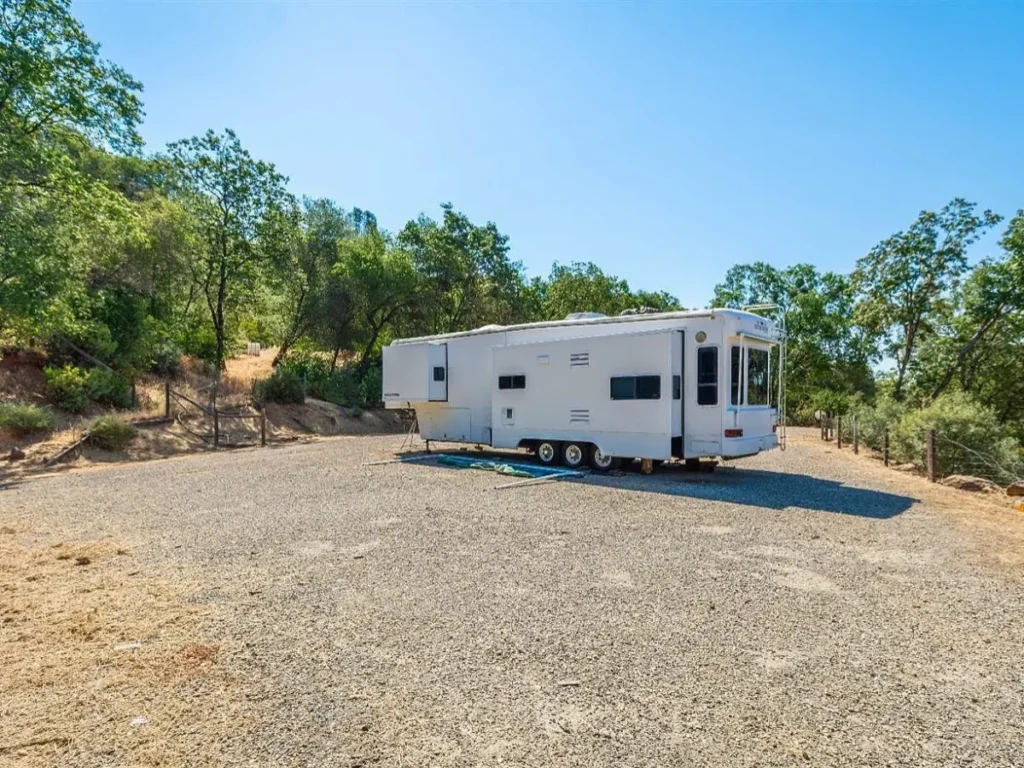
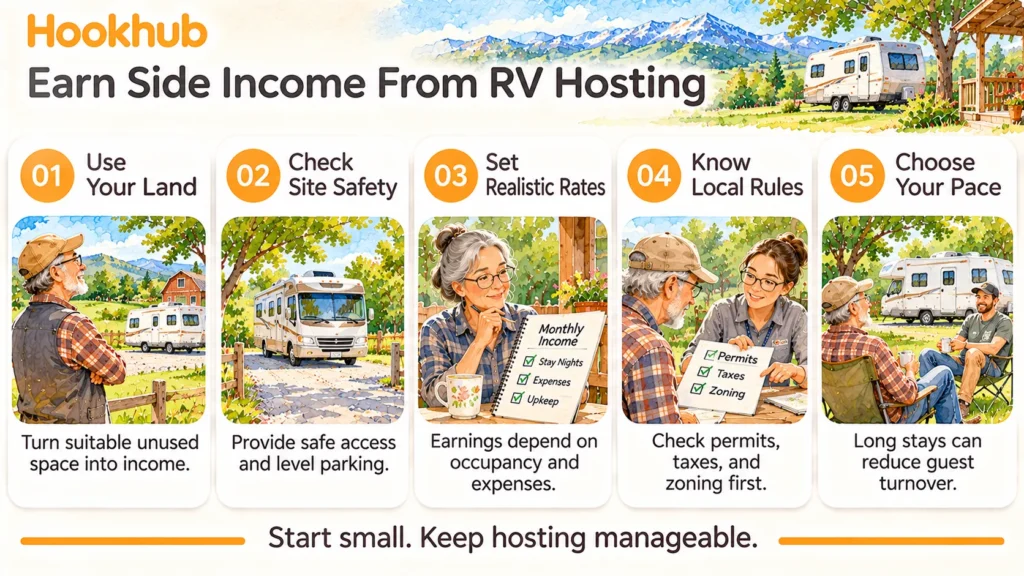
The first consideration is accessibility. RVs require adequate space to enter, maneuver, and park safely. A site that appears spacious for a passenger vehicle may feel very different to someone driving a 40-foot motorhome.
Next, consider the parking area itself.
Most travelers look for:
- Reasonably level ground
- Safe vehicle access
- Clear entry and exit routes
- Minimal hazards
- Adequate space between neighboring structures
Beyond basic accessibility, think about how guests will use the space day-to-day. Is there enough room for slide-outs? Can larger RVs enter and exit without backing into difficult areas?
Does the site remain accessible after heavy rain? Small operational details often have a bigger impact on guest satisfaction than expensive upgrades.
You don’t necessarily need hookups to attract guests. Many RV travelers actively seek boondocking opportunities where they can enjoy privacy without utility connections.
Before spending money on improvements, it helps to understand the real return on investment of a gravel pad versus full hookup RV site and which option makes the most sense for your property.
Location can also influence demand. Properties near national parks, recreation areas, seasonal travel routes, small towns, or major highways often attract more interest, but even remote properties can perform well when marketed appropriately.
The best way to evaluate your land is to focus on practicality rather than perfection. Travelers generally value safety, privacy, and ease of access more than luxury amenities.
The Financial Benefits of RV Hosting for Retirees
For many retirees, the appeal of RV hosting comes down to one thing: financial flexibility.
A supplemental income stream can help create greater financial security without requiring significant lifestyle changes.
Many retirees face ongoing expenses such as:
- Property tax payments
- Insurance premiums
- Utility bills
- Equipment maintenance
- Fence repairs
- Driveway maintenance
- Landscaping expenses
Even a few hundred dollars per month can help offset these costs.
The financial benefits become even more significant when hosting income is viewed as part of a broader retirement strategy. Rather than relying solely on savings, pensions, Social Security, or investment withdrawals, landowners gain another source of revenue that can help preserve other financial resources.
Because you’re utilizing land you already own, startup costs are often relatively low compared to launching a traditional service business.
For retirees who value independence, that can be an attractive advantage.
What Can You Realistically Earn?
RV hosting income varies based on location, available utilities, seasonal demand, pricing, and how often your space is occupied.
For retirees considering one RV parking space, a simple monthly calculation is often more useful than an annual earnings estimate.
Consider a property charging $650 per month for a long-term RV space:
| Occupied Months Per Year | Gross Annual Revenue |
|---|---|
| 3 months | $1,950 |
| 6 months | $3,900 |
| 9 months | $5,850 |
| 12 months | $7,800 |
These are illustrative figures, not guaranteed earnings. They also represent gross revenue before platform fees, utility expenses, maintenance, insurance, taxes, or property improvements.
A retiree who already has a suitable parking area and nearby utilities may have relatively low startup costs. Someone who needs to install electrical service, improve a driveway, or add wastewater infrastructure could face a much larger initial investment.
Monthly bookings may be especially attractive for hosts who prefer fewer arrivals and departures. One guest staying for 60 or 90 days generally requires less turnover management than several short-term bookings, although the host still needs to remain available for questions, maintenance, and occasional issues.
Seasonal demand also matters. Properties in warm-weather destinations such as Arizona, Texas, and Florida may appeal to winter RV travelers, while other locations may attract more guests during summer or local work seasons.
The goal is not necessarily to maximize revenue. For some retirees, earning enough to offset property taxes or annual maintenance costs may make hosting worthwhile without requiring year-round occupancy.
Before setting your rates, review this RV hosting budget allocation guide for a deeper look at expenses, revenue planning, and long-term profitability.
Understanding Tax Considerations
Whenever income is generated from property, tax considerations deserve attention.
Hosting income may affect your tax situation depending on your location, earnings, and specific circumstances.
Potential considerations include:
- Reporting rental income
- State tax obligations
- Local requirements
- Recordkeeping responsibilities
- Deductible property-related expenses
Because tax regulations vary by state and individual circumstances, consulting a qualified tax professional is often the smartest approach.
A tax advisor can help you understand:
- What records to maintain
- How hosting income should be reported
- Whether improvements may affect deductions
- How hosting fits into your broader financial plan
Good recordkeeping from the beginning makes the process significantly easier later.
How Could Hosting Income Affect Your Retirement Finances?
Additional income can be helpful during retirement, but the amount you earn isn't the only number that matters.
Depending on how your hosting activity is structured and your personal financial situation, rental income may affect your taxable income, the taxation of Social Security benefits, or income-based programs.
For retirees receiving Medicare, higher income can also affect future Part B and Part D premiums through income-related adjustments. Not every hosting arrangement has the same consequences, and rental income is not automatically treated the same way as wages or self-employment income.
Before counting on hosting revenue as part of your retirement budget, consider discussing the arrangement with your tax advisor or financial planner.
A few questions worth asking include:
- How should the hosting income be reported?
- Which property expenses may be deductible?
- Could additional income affect taxes on Social Security benefits?
- Could it affect Medicare premiums or other income-based benefits?
- How much of the revenue should be reserved for taxes, repairs, and unexpected expenses?
For many retirees, the goal is a manageable amount of additional income that improves financial flexibility without creating unnecessary complexity.
Understanding State and Local Regulations
One area that often causes concern among new hosts is regulation.
The good news is that most concerns can be addressed through basic research before listing.
Regulations vary by state, county, and municipality. Some areas have few restrictions regarding private RV hosting. Others may regulate occupancy limits, stay durations, permitting requirements, or utility standards.
Before accepting bookings, contact your local planning or zoning office to understand any requirements that may apply.
It's also helpful to review the broader legal considerations for RV hosting on private land so you understand common zoning, permitting, and occupancy questions before listing.
Taking this step early helps protect both your investment and your peace of mind.
Common Mistakes New Hosts Make
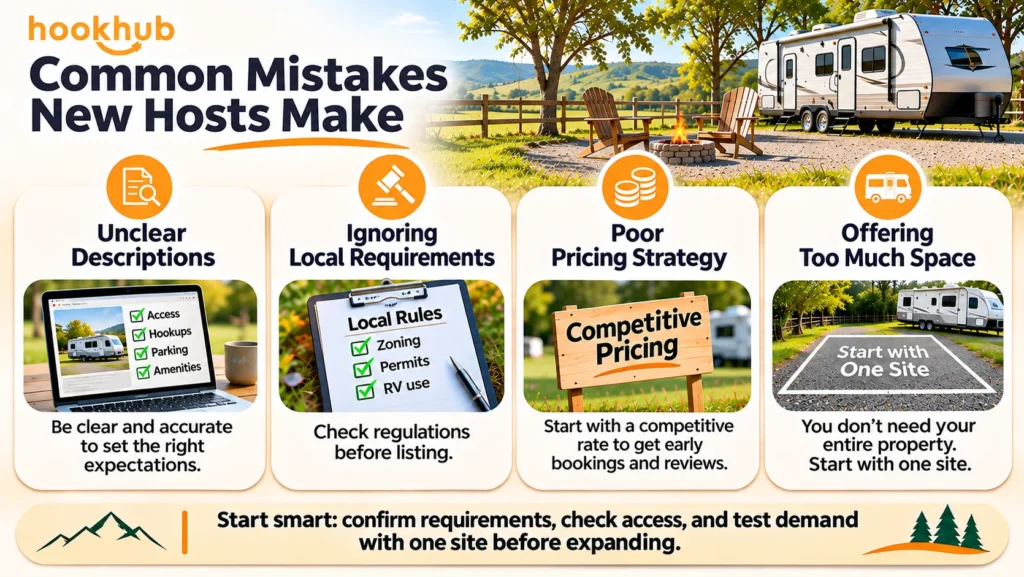
One common mistake is investing in improvements before determining whether the property is suitable and whether local demand justifies the expense.
Before building a new RV pad or installing expensive hookups, confirm local requirements, evaluate vehicle access, and compare similar properties in your area.
Starting with one suitable site can help you test demand and learn what guests value before expanding.
Other common mistakes include:
Unclear Property Descriptions
Guests appreciate accurate information. Clear expectations reduce misunderstandings and improve reviews.
Ignoring Local Requirements
Researching regulations before listing helps prevent future issues.
Poor Pricing Strategy
New listings often benefit from competitive pricing that encourages early bookings and positive reviews.
Offering Too Much Space
You don't need to dedicate your entire property. Many successful hosts begin with a single site.
Where Hookhub Fits Into RV Hosting for Retirees
Many retirees are interested in hosting but worry about the practical details.
How do you accept payments?
How do you verify guests?
How do you manage reservations?
How do you protect yourself from unnecessary risk?
This is where Hookhub provides value.
Instead of piecing together multiple systems, Hookhub gives hosts a structured way to list their property, manage bookings, receive payments, and communicate with travelers.
The platform is designed specifically for RV hosting, which means its tools focus on the needs of both landowners and travelers.
Landowners can also browse active RV sites to better understand pricing, amenities, and how other successful hosts position their properties.
Hosts can create listings, establish property rules, review booking requests, and manage reservations from one place.
Identity verification and host protection features help provide additional peace of mind.
For retirees seeking simplicity rather than complexity, these tools can make the difference between feeling overwhelmed and feeling confident enough to get started.
How to Get Started
Getting started is often easier than people expect.
Begin by evaluating your property honestly.
Ask yourself:
- Is there safe vehicle access?
- Is there adequate parking space?
- Can guests stay comfortably and safely?
- Are local regulations supportive of hosting?
Once you've answered those questions, it's time to create your host listing and determine how you want to welcome guests to your property.
Focus on accurate descriptions and quality photos. Travelers want to understand exactly what they're booking.
Set reasonable expectations regarding amenities, access, pets, generators, and quiet hours.
Start with one site rather than trying to maximize capacity immediately. This allows you to gain experience, learn what guests value, and make informed improvements over time.
The goal isn't perfection. The goal is getting started with a manageable, sustainable approach that allows you to test demand before making major investments. Many hosts are surprised by how quickly a new listing can begin attracting inquiries.
Is RV Hosting Right for Every Retiree?
RV hosting can be a good fit for retirees who have suitable property and want to generate additional income without committing to a traditional job.
But it's worth considering how hosting will affect your everyday life.
Some retirees enjoy having occasional guests nearby and appreciate the opportunity to make productive use of their land. Others prefer complete privacy and may find even a quiet, respectful long-term renter more disruptive than expected.
Before listing, ask yourself:
- Privacy: Will guests be parked near your home, outdoor seating areas, or frequently used parts of the property?
- Availability: Are you comfortable responding to questions, maintenance requests, or occasional problems during a stay?
- Physical work: Can you maintain the parking area, manage access, and handle minor upkeep yourself, or would you need to hire help?
- Travel plans: If you spend part of the year away from home, who will handle an issue that requires someone to visit the property?
- Guest turnover: Would you prefer one monthly renter or several shorter stays throughout the season?
- Financial expectations: Would a few occupied months per year make hosting worthwhile, or would you need consistent bookings to cover your costs?
Long-term stays can reduce the number of check-ins, checkouts, and guest transitions, making them appealing for hosts who prefer a quieter routine. However, a monthly renter also becomes a more consistent presence on the property.
For some retirees, hosting one RV during a particular season is the right balance. Others may prefer year-round availability or decide that keeping their land private is more valuable than the potential income.
The best arrangement is one that supports your retirement lifestyle rather than creating a second job you never intended to take on.
Final Thoughts
RV hosting isn't a get-rich-quick scheme, nor should it be viewed as a replacement for a comprehensive retirement plan.
What it can provide is something many retirees value deeply: flexibility.
The ability to generate money from unused land, improve financial security, offset property tax expenses, and create a new income stream without taking on a traditional job is appealing for many landowners.
The strongest hosts rarely begin with elaborate infrastructure or large investments.
They start with a practical assessment of their property, realistic expectations, and a willingness to learn.
If you have land that sits unused for much of the year, RV hosting may be worth exploring. Demand for private RV stays continues to grow, and many retirees are discovering that a small portion of their property can generate meaningful income while requiring surprisingly little effort.
Frequently Asked Questions
How much money can retirees earn from RV hosting?
Earnings depend on location, monthly rates, occupancy, amenities, and operating expenses. For example, one RV space rented for $650 per month over six months would generate $3,900 in gross revenue before expenses.
Do I need hookups before I can start hosting?
No. Many travelers specifically seek dry camping or boondocking locations. A safe and accessible parking area is often enough to begin.
Will hosting affect my taxes?
Hosting income may have tax implications. Because requirements vary by state and personal circumstances, consulting a qualified tax professional is recommended.
Can I host if I don't live on the property full-time?
Yes. Many hosts manage properties remotely, particularly when focusing on longer-term stays and providing clear guest instructions.
How does Hookhub help hosts?
Hookhub helps hosts manage listings, bookings, payments, guest communication, identity verification, and host protection, making the hosting process easier to manage.